Marius Billgobenson is not just an artist; he's an ambassador whose life experiences and passion for music have shaped his extraordinary journey. Hailing from the Congo and now residing in Stockholm, Sweden, Billgobenson's artistic prowess transcends borders, making him a true musical citizen of the world.
Billgobenson is proud to release his highly anticipated single "A Little Bit of Honey" — a smooth anthem for weary ears recorded in Los Angeles with two-time grammy winning producer Paul Brown. “Honey” is a poetic expression of love and the transformative power it holds. This soulful track invites listeners into a world of warmth and affection, where the sweetness of life is celebrated through captivating melodies and heartfelt lyrics.
Infused with jazz, R&B, and soul influences, “A Little Bit of Honey'' showcases Billgobenson’s musical versatility and Brown’s production expertise. The track had help from editor Jaqui Brown and was backed by sought-after session musicians David Garfield, Ron King, Tony Braunadel, Shane Theriot and Freddie Washington.
Drawing inspiration from legendary artists such as Van Morrison, Bill Withers, and Bob Marley, Billgobenson's music is a fusion of their songwriting prowess and his unique artistic vision. His latest release is a testament to his creative evolution and his commitment to crafting emotionally resonant melodies and heartfelt lyrics.

Marius Billgobenson's roots lie in a small Congolese village, where he was immersed in the enchanting sounds of the local people and their harmonious existence with the forest. His upbringing, coupled with his experiences living among the forest people during Congo's civil war, laid the foundation for his musical career. Witnessing the discrimination faced by marginalized communities fueled his activism, leading him to amplify their voices through his music.
During the war, Billgobenson spent months in the forest, facing unimaginable challenges. Yet, amidst adversity, he found solace in the traditional knowledge and care of the forest people, emerging with a renewed appreciation for life and a commitment to human rights advocacy.


No one would ever mistake singer-songwriter/guitarist Clara O'Page as the shy type. As the mastermind and frontwoman behind the genre-bending Montreal mavericks Debbie Christ, O'Page rifles through an array of musical styles, topics, moods and perspectives like a stage actor going through costume changes. Now, with their thrilling full-length debut Tower, O'Page and her bandmates stand poised to topple our collective inhibitions around shame, sexuality, and trauma with a theatricality and fashion sense that hits hard while also making the subject matter more palatable.
"I'm the youngest of six," O'Page explains, "so I was encouraged to be funny and outgoing — I love to be goofy and make people laugh — but vulnerability was foreign to me. I grew up in an Evangelical household where you just don't talk about the icky bits. You save those for God. On top of that, my dad's side is English. It's a very repressed cultural mindset. So, where I'm typically a clown day to day, music is my place where I can be more serious. Getting into punk music, I gradually got more comfortable disclosing my feelings. I learned that it can be revolutionary just to simply say what you're actually feeling. That's very profound for someone like me. Like I'm not someone who cries very easily, so music is how I do my crying. And it evolved to the point where there's now a definite shock-value element."
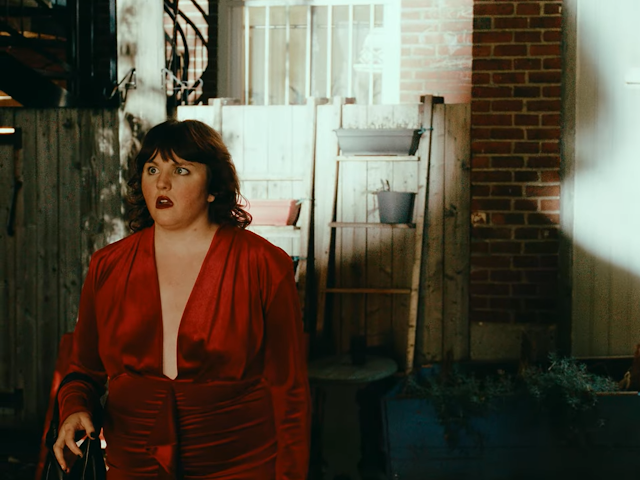
The video for the single "Lust!" is the ultimate case in point. Suffice it to say you'd be hard-pressed to find another example of sexual violence portrayed with such stylishness and verve. "Stylish" isn't a word we typically associate with assault, but Debbie Christ and director Aaron Nadal have somehow managed to pull-off the impossible in their portrayal of physical violation as a metaphor for addiction.
"I'm not trying to piss people off," she adds with a laugh, "but I feel like people need to be shaken up. There are too many ways that we're all just so... bound-up. And it would benefit us all to just be able to break free and have room to breathe. My favorite photographer, for example, is Robert Mapplethorpe. I'm really inspired by his ability to make people question what art is versus what's just vulgar and over-the-top. And I like dwelling in that place where you're kind of squirming in your uncertainty. If you do that with a conscience — if you actually have a point — I feel like that can be very useful. Especially if the music underneath really grabs you. And that's where all the different styles come in. We're trying!"
An explosive mix of surf, garage, psychedelia, shoegaze, glam, punk, folk, and spoken-word, Tower jolts the "confessional music" stereotype into an all-new, decidedly assertive artform, even as O'Page's songs reveal softness and unguarded disclosure as a superpower. At times, Tower echoes the stylish minimalism of The Velvet Underground. At other times, Debbie Christ channels an avant-glam sensibility that would've made the likes of David Bowie and The New York Dolls proud. Elsewhere, serrating bursts of naked emotion split the difference between Patti Smith, PJ Harvey and contemporary art-pop experimentalists like Sasami.
Indeed, Tower allows us to imagine what it would be like if pop mavens like, say, Debbie Harry or Pat Benatar had been born a generation later and fronted the Canadian folk-punk trio And The Kids. Or, for instance, if Angel Olsen had been born a generation earlier and joined Alice Cooper at the height of their druggy eccentrism.
Speaking in a prayer-like cadence at the beginning of Tower, we hear O'Page incanting the words “Elixir of life, I ask for light... I am given sound”.
For O'Page, one form of expression can always swap places with another. "For me," she explains, "the act of making music is more like mixed media. My journals are very tactile, and I see slow fashion almost as like a new punk movement. I almost can't help but see all of these things as going hand in hand — melodies, phrases, visuals, and fabric are always sloshing around in my head. When people listen to the album, that's the sense I want them to get."